What do you provide?

Every now and then, it’s healthy to pause and reflect on the work that you want to do. I’m embarking on a set of exercises to re-think and focus, and am sharing it with you. Join in if you’d like and we can journey together.

EXERCISE 2: What do you provide?

What do people buy when they buy something from you?
  • People buy peace of mind – knowing that I will get the job done well.
  • They buy a fresh perspective – knowing that I will bring new ideas to the table.
  • They buy a long-term relationship – knowing that I have their best interests in mind and am in it for the long run.
  • They buy a guiding light – knowing that I will go above and beyond just delivering the service, but am also invested in education (teach to fish rather than give a fish)
  • They buy a great working experience – knowing that I always bring enthusiasm, warmth and a smile to every job
Leave out the easy, repetitive, generic stuff… What are you doing that’s difficult?
  • staying disciplined about building healthier habits – early to bed, early to rise, eat well, hydrate more, learn something every day
  • staying disciplined about keeping in touch regularly with past clients, and old friends (need to get better at it)

—-

I’m doing this as part of Seth Godin’s Udemy course for freelancers. Feel free to embark on this discovery for yourself too.

Who am I?

Every now and then, it’s healthy to pause and reflect on the work that you want to do. I’m embarking on a set of exercises to re-think and focus, and am sharing it with you. Join in if you’d like and we can journey together.

EXERCISE 1: Who Are You?

What do you want to do? (Not your job, but your work, now, tomorrow, and in the future)
I want to use my skills in video to help changemakers maximize their impact and reach.
What do you want to change, and how do you want to change them?
I want to change how so many amazing people and organizations are changing their communities and doing remarkable work, and yet hardly anyone knows about it. They struggle to communicate the difference they are making, and find difficulty getting the support they need to remain sustainable.
I can change this in 3 ways:
  1. Educate the change makers – arm them with the video skills necessary to communicate their story effectively. Through in-person workshops and/or online courses.
  2. Educate the video makers – help nurture even more storytellers for good – help them hone their craft, and learn how to make this a viable career. Through in-person workshops and/or online courses.
  3. Tell their stories – make engaging documentaries to tell stories around social issues, then screen them far and wide to spur discussion, debate, and spark action
How much risk? (from 1 [a little] to 10 [bet everything]), how much are you willing to put at stake to make the change you seek?
8. I’ve already given up a stable job doing corporate training videos to plunge into doing the work above full-time. The only thing I prioritize above this is my family, who support and believe in me.
How much work are you willing to do to get there? Be specific about the tradeoffs.
I am willing to do the work 6 days a week.
This will require staying disciplined – building good habits of waking up early to jump-start the work each day, and making good food choices and staying active to ensure I am healthy enough to carry on long-term.
The tradeoffs are: no tv, less social time, investing my money back into the cause instead of blowing it on vacations, entertainment, or luxury items.
Does this project matter enough for the risk and the effort you’re putting into it?
 
Absolutely. I feel it is my calling.
Is it possible – has anyone with your resources ever pulled off anything like this?
 
Yes. While I am not aware of anyone who is doing the exact same thing I want to do in the way i want to do, I know many in the arts who are teaching while making amazing art.
Doing this as part of Seth Godin’s Udemy course for freelancers. Feel free to embark on this discovery for yourself too.
Creative Fundraising and Audience Engagement

In these tough times of shrinking budgets and attention spans, we are forced to think of creative ways to raise funds and keep our audience engaged. Here’s how I found one unique avenue, right when I least expected.

Intuitive Technology

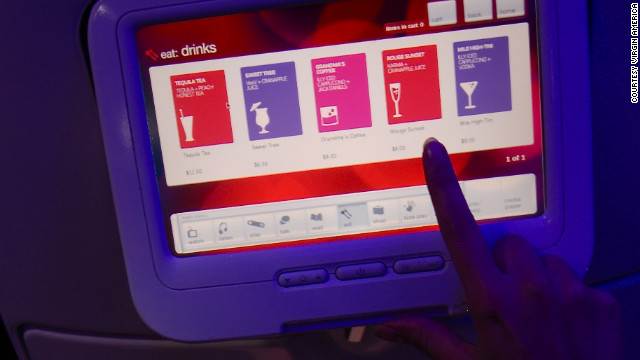
I had my virgin flight with Virgin America Airlines recently, and while I was impressed by the sleek plane design and cheeky safety announcements, I noticed something in front of me that I’d never seen on any other airline – a touch screen monitor. On it were instructions on how to use the touch screen navigation bar to watch movies on demand, free tv, and even order food.

touch screen menu on board virgin america airplane

Hungry? All I had to do was browse through their selection of snacks and beverages (options for the health-conscious included), add them to my cart, swipe my credit card through the built-in slot, and voila! The flight attendant brings my order to me in a matter of seconds. It felt just like shopping on Amazon.

Applied To Do Good

So I thought to myself… what if this same technology could be engaged to ask for donations? On board an aircraft, you have a captive audience, most with time to spare. How about making it such that a passenger could watch my documentary for free, and then at the end, be shown an easy way he/she could take action and support the cause on the spot?

Inspired, I dug around their menus a little deeper and stumbled upon an example that came quite close! Thanks to Virgin Group founder Richard Branson‘s participation in the Stand Up 2 Cancer movement, the entire fundraising show was available for viewing on board for free. And true enough, there was a line in the show description that said that if I wanted to donate to Stand Up 2 Cancer, I could simply navigate to the online store to do so.

Almost perfect! The down side was it was a little challenging to find my way from the entertainment section to the store section, and then to the section where a few non-profit organizations were listed and people could donate to their chosen cause. Because it’s so difficult to keep an audience member engaged, we always want to minimize the number of clicks a person has to make before completing a transaction. I’m looking forward to the day when the technology enables us to make the donation on the spot right at the end of the show/movie.

That said, big kudos to Virgin for making the ability to support great organizations on board your planes available. I haven’t seen the ability to do this anywhere else… yet! And this whole experience makes me wonder… what if we could implement similar technology in other places where people tend to sit for a period of time… like a movie theatre? How would that change the way we raise money and engage audiences? What other innovative methods have you seen in your community? Share your thoughts below!

—- Liked this post? Subscribe to my free Media For Social Change newsletter.

Pushing boundaries with Fear Experiment

“Do one thing everyday that scares you.” – Eleanor Roosevelt

Imagine going from zero experience in an art form that scares you, to performing that very art form in front of 750 people at a major concert venue in your city. Fear Experiment is one experience that’s helped over a hundred adults take fear face on over the last few years in Chicago.

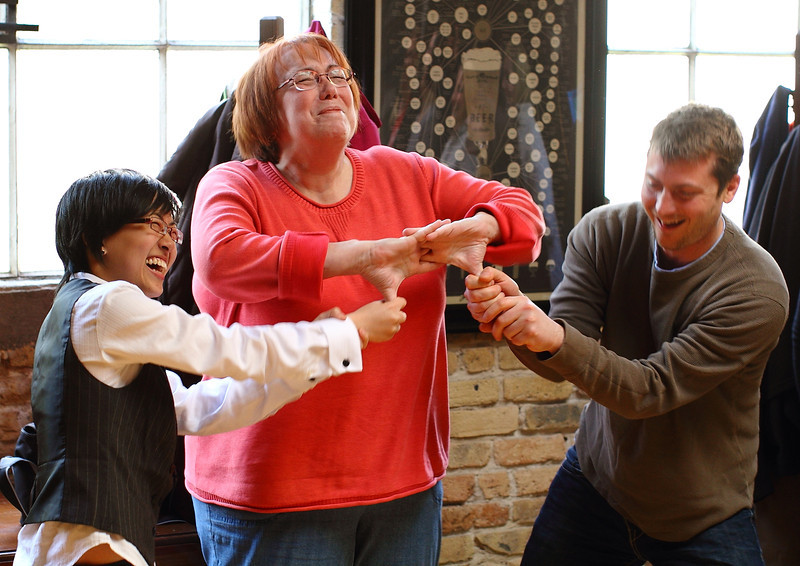
Good laughs at improv practice

Fear Experiment creator Saya Hillman made the sign-up criteria clear – you sign up solo (so everybody starts off as strangers), and the idea of doing FE has to scare you. You must have had no formal training in dancing, improv, a capella singing, or stepping, and you’ve gotta be ready to be practicing twice a week for 3 months before being thrust on stage. Everybody has to work together and be supportive of each other. It’s kinda like summer camp for adults. One filled with like-minded individuals looking for a challenge.

People sign up for various reasons. Some do it to overcome social anxiety, some do it to be a good example to their kids. ABC7 News featured a stepper who proved just this past Saturday at Fear Experiment 3 that being deaf was no obstacle too big for her. When I signed up to do the improv portion, it was to push myself to speak my mind off the top of my head more. Growing up in a culture where sharing one’s opinion both at home and in school was never encouraged, I found myself struggling to participate in class at Northwestern; constantly over-thinking what I was about to say, afraid to offend or be incoherent.

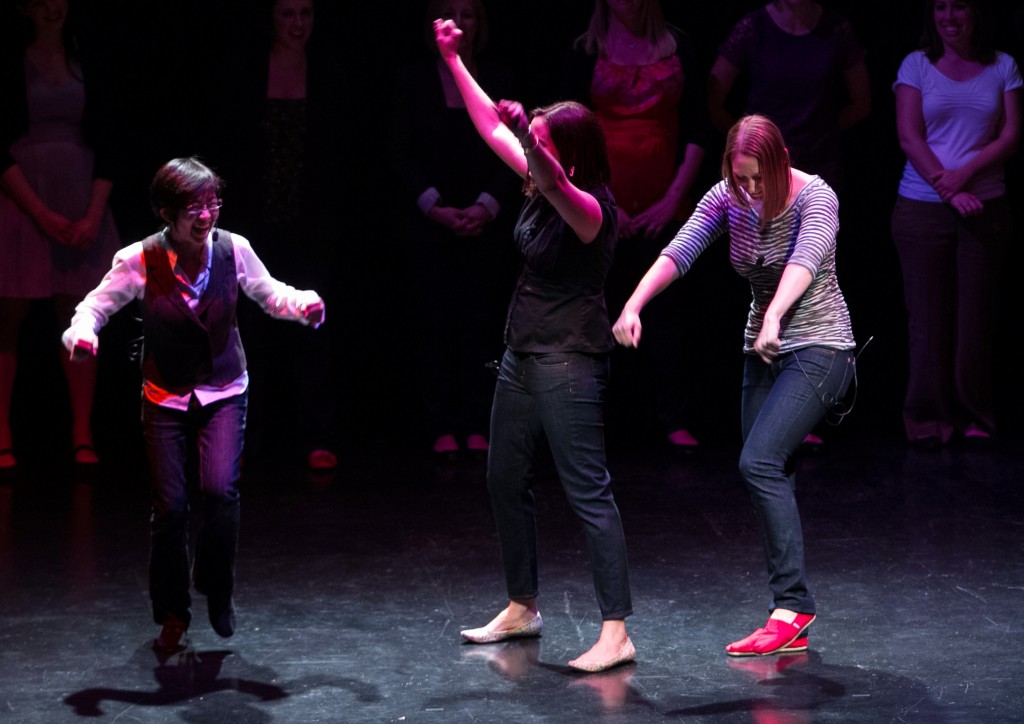
On stage performing improv at Fear Experiment 2. (Shh... don't tell anyone we were pretending to be the Backstreet Boys.)
On stage performing improv at Fear Experiment 2. (Shh… don’t tell anyone we were pretending to be the Backstreet Boys.)

Learning improv in a fun, cozy environment that wasn’t already filled with people who were really good at it was a huge help. Our improv coach Pete did a great job of helping us all build trust in one another, so we would be better able to let go of our inhibitions and fear of being judged. We also practiced tuning out our inner self-critics (what Seth Godin fans refer to as The Lizard Brain). You know, the one constantly going “you’re not funny enough,” or “you look really ridiculous”. I also laughed hard enough at every practice to build some ab muscles. ;)

All in all, an absolutely fulfilling experience with a wonderful, diverse community and something I’d definitely recommend anyone. Friends don’t let friends get stuck in mundane work-eat-sleep cycles. There’s more to life than that. Go. Do something that scares you!

Here’s a peek at what happened pre and post-Fear Experiment 2:

While applications for Fear Experiment 4 are closed, you can still get on the waitlist here.

[Video Details]
Cinematography by: John Fecile and Jon Vogel
Producing & Editing by: Shuling Yong
Interviews conducted by: Lauren Harper