People protect what they love…

“We can’t protect what we don’t yet understand” – Jacques Cousteau

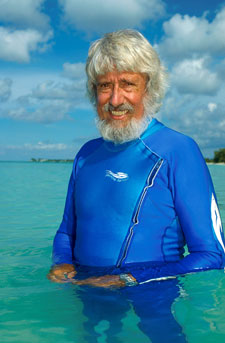
That was my big takeaway from watching Jean-Michel Cousteau’s presentation The Other 70%: Understanding the Earth’s Underwater Ecosystems on this 40th Anniversary of Earth Day. He spoke to a packed auditorium at Northwestern’s Pick Staiger Hall, sharing his life passion for ocean exploration and conservation.

He told the story of how he was first “thrown overboard” by his father at age 7, and how he now has his two children working alongside him to inspire and educate people around the world about the need to maintain a sustainable ocean.

Sharing multiple clips from his PBS/KQED series “Jean-Michel Cousteau Ocean Adventures“, he was able to illustrate with vivid imagery the beauty that lies in the depths. Through watching them, I understood how our actions were seriously endangering the existence of our wild turtles, sharks, birds and whales. I also learned about Jean-Michel’s role in influencing President Bush’s 2006 decision to designate the North Hawaiian Islands Marine National Monument to preserve 138,000 square miles of ocean.

But the clip that truly resonated with me was one which depicted 5 people across a spectrum of ages and diets getting tested for the presence of toxic substances in their bodies. The cameras were rolling as each person in the study was told the test results for the first time. The emotion captured on their faces was incredibly moving. You could totally see the shocking realization of how great an impact our environment and diet can have on our health. After the initial tears, came the renewed determination to protect and prevent others from suffering the same consequences.

And that, to me, was a step in the right direction following a higher level on understanding. Jacques was right. We can’t protect what we don’t yet understand. I’ve seen this ring true in my life too. The conscious lifestyle choices I make today are the result of me learning and gaining more knowledge about environmental and sustainable food issues. Knowledge is power, indeed.

Happy 40th Earth Day. :)

Subscribe in a reader

Bookmark and Share

Guide to Greener Electronics

What factors do you consider when it comes to buying a new phone? Price? Functionality? Battery life? Well, here’s one more thing to consider on your next purchase – how responsibly produced it was. Thanks to Greenpeace, we now have a simple, colorful chart to determine just that!

Want more details? They’ve also compiled a great report giving scores to each company in things like ‘Amounts of renewable energy used’, ‘chemicals management’ and ‘energy efficiency of new models’. Read the full report in their guide-to-greener-electronics-14-edition.

Subscribe in a reader

Bookmark and Share

Fighting poverty and pollution with one solution.

Two huge challenges facing us today are the ecological crisis we’re in and the social crisis of the widening gap between the rich and poor.

Van Jones of Green for All (and former Special Advisor for Green Jobs, Enterprise and Innovation at the White House Council on Environmental Quality ) suggests in the short video below that the solution to tackle both poverty and pollution is to build a green economy. With the increase in demand for green technology across the world, comes the increase in demand for labor. A lot of work needs to be done in retrofitting homes, and in harnessing alternative energy sources. A lot of people need work. Bring together the two and you get green collar jobs.

He also brings up the issue that our governments are currently partners to the polluters, war-mongers and incarcerators. They need to start partnering up with the problem solvers in the world.

[Youtube=http://www.youtube.com/watch?v=3IUVpwx23cY]

Is the solution that simple? What tangible steps can we take to get there?

Subscribe in a reader

Bookmark and Share

Singapore and climate change.

21 youths from ECO Singapore had the chance to engage in important dialogue with Singapore Prime Minister Lee Hsien Loong at COP15.

What is a small country’s place in the world during these times? With no natural resources, how might we find alternative energy sources? Is imposing higher carbon taxes really a viable option? What kind of impact will our eco efforts have on the economy and Singapore’s ability to remain competitive?

Learn more about Singapore’s stand on the environment and our climate change policies through their two-part video.

[Youtube=http://www.youtube.com/watch?v=Kxfbnyd8NLQ]

[Youtube=http://www.youtube.com/watch?v=K5D3Z0ltGLE]

Read more about ECO Singapore’s experience at COP15 here.

Subscribe in a reader

Bookmark and Share