If you’re like me, you grew up enjoying a slew of simulation games that transported you into another world. You ran lives with The Sims, you ran your own theme park with Roller Coaster Tycoon, and you ran your own transportation company with Transport Tycoon.
Well, what if all that you were building up in your fantasy world on your computer screen was actually taking place in a remote location in real life? The folks at agricultural firm Azienda Agricola Giacomo Ferraris have made it possible with their website –Le Verdure Del Mio Orto(‘The Vegetables from my Garden’). It lets you grow your own organic vegetable garden right from the comfort of your home. You’ll get to remain in your boxers, sipping on your cup of coffee and still have fresh pesticide-free produce to nourish you.
That’s because once you’ve paid for your plot of land and designed your virtual farm online, they’ll build an actual farm in northern Italy with the exact crops you chose. Once the produce grows, it’s picked and delivered to your doorstep within 24 hours. Brilliant.
Still not sure how it works? Check outthis reviewon Springwise.com. You can also visit the actual (Italian) sitehere.
I’d love to see an expansion into other countries too. Their site is colorful and fun! Now if only I could read Italian.
I came acrossthis articleon theAshoka Techpage highlighting the 6 common pitfalls in product design for social good. Yep, good intentions don’t always lead to a successful outcome. The one that stuck out to me most?
“Pitfall #3: Failing to understand the user context. According to a study conducted by Duke University, up to 98% of donated medical equipment in developing countries is broken within five years. One major culprit? Power surges. Most donated equipment is designed for developed countries, where constant, reliable electricity supply is the norm. But in developing countries (particularly in rural areas), hospitals frequently face blackouts or brownouts, which end up frying their medical devices. While touring Pathan Hospital in Nepal, Tim’s design team discovered a cheap and simple solution; adding surge protectors to medical devices could prevent breakdowns and allow rural hospitals to save money on equipment. From this experience, Tim learned that context is king. Understanding situational nuances (especially in base-of-pyramid markets) allows entrepreneurs to better tailor their products and solve specific problems.”
No one understands a challenge better than the locals. Seeing ourselves as the all-knowing being coming to “save” the poor and implementing blanket solutions to a situations we have not lived with or fully understood may lead to more harm than good.
Imagine this. You send a team of experts to a developing country to build wells for the locals. The completed wells is successfully bringing them fresh, clean water. Your work is done and you move on. 5 years later, a part of the mechanism in the well breaks. None of the locals have the knowledge or the needed materials to repair it, leaving them no choice but to abandon it. Not quite the solution you imagined, is it?
What might have worked better? Collaborating with the local craftsmen and engineers to fuse your knowledge with theirs, and construct the well with materials available locally. Train the locals on how each well works, so they’ll have the knowledge to keep the wells running long after you’re gone.
They brought up a great example of technology that’s been designed and implemented successfully… the Kinkajou Projector. Though it’ll take me a little more research to understand how they worked with the locals to develop the product, this video gives a great overview of a low-cost, low-powered device that is changing lives.
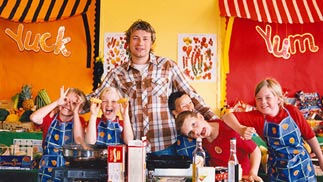
So the big news is out. Jamie Oliver wins the 2010 TED Prize. Each winner receives $100,000 and, more importantly, the granting of “One Wish to Change the World”. Through TED’s extensive network of sponsors, conference attendees and online community, the prize winners have doors to powerful collaborative opportunities swing wide open. (Read more about Jamie’s win here)
Jamie has spent years trying to revolutionize the way we eat and live by getting us off unhealthy eating habits and getting us to cook again. Even with 12 tv series that’s been aired in 130 countries and 10 cookbooks in 29 languages, Jamie is set to create even bigger change. As far as I can remember, I was a big fan of his campaign School Dinners. His mission was to ban junk food in schools and get kids eating fresh, tasty and nutritious food.
“What we eat affects everything: our mood, behaviour, health, growth, even our ability to concentrate. A lunchtime school meal should provide a growing child with one third of their daily nutritional intake.”
I remember watching an episode where he cooked a tray of food and placed it next to a tray of deep fried chicken nuggets and fries in the dining hall. The kids, who came through the buffet line were so unused to seeing fresh, healthy options, mainly chose to go with the unhealthy stuff they’d been so used to putting in their mouths. They just didn’t know any better. It was a sad realization of how we’ve been conditioned, and why the level of obesity in children has doubled over the last decade. In fact, it’s estimated that the number of obese people in the world will rise to 2.3 billion within the next 5 years!
What’s the situation with schools in Singapore? Looking back, I remember that deep fried chicken nuggets and hot dogs formed a big part of my diet in primary school. Ice cream and fizzy, sugar-laden drinks were easily available too. Things were a little different in Secondary school. There was no ice cream in my first two years there. Frozen yogurt made its way in later on though. I also believe we didn’t have any options to buy coke or any other carbonated drinks. Although I’m not so sure my daily dose of Pokka green tea was a much better choice.
Photo by Kevin Krejci
All this leads me to wonder… what are they feeding students now? Think about it. If they typically have two meals a day, five days a week in that dining hall, that’s a big part of their diets. The system works a little differently back home, where instead of paying for a fixed meal plan for the semester and then getting food from a buffet line, students still have the power in their hands to choose what food to buy from a variety of 8 – 10 different stalls. This means that stall holders are motivated to sell the products that have the highest demand. So apart from getting the authorities to crack down on what can be sold, an alternative way to get healthier choices on the menus is to educate the kids so they start to demand better food.
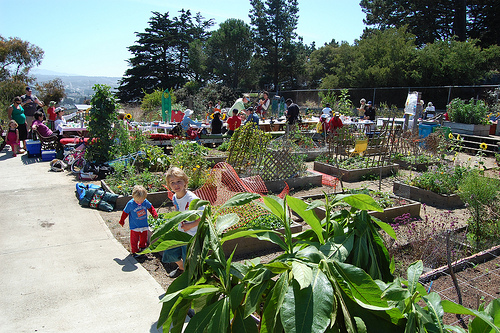
Health education from books isn’t cutting it anymore. Take them out to visit farms and gardens. Teach them through hands-on practice ways to do urban farming. Get experts to come into class to give real life examples of what they can do. So much can be done!
What was your experience with food in school like?
You’ve watched, you’ve laughed, you’ve forwarded them to your friends. These are the top 10 brand-driven videos of the year according to Visible Measures.
Standing at the number one spot with a reach of over 50 million? Those adorable roller-skating babies on the Evian ad.
Two things that’re almost sure winners in vids – animals and kids.Although I have to admit that watching those babies perform stunts I know they’re physically incapable of at that age irked me a little.The debate in my head on whether it was entirely motion-graphics or whether they filmed actual baby heads and stuck them on animated bodies took away from the cuteness factor.
Ranked at number two with over 26 million in reach is the T-Mobile Dance video.
Very fun. Makes me wish I were a part of it. Very fun to watch the prep too. Took place on Jan 15th 2009. Felt sad at the realization that the HTC Dance in Singapore actually came 10 months after. Not as original as I thought, especially since they’re both mobile phone companies. Still can’t beat the one atOprah’s showthough… Huge scale surprise right on the streets of Chicago… the best one in my opinion!
Microsoft Xbox’s Project Natal video takes the number three spot with a reach of over 22 million.
Only two videos in the top ten list gave me the urge to show them to my friends. This was one of them (the other was by Volkswagen). I love how it cuts right to the chase. No babies, no dancing, no outrageous stunts. Just a demonstration of the product and people using it. Very cool.
Check out the full list and stats on Advertising Age here. Thanks to @geekonomics for the tweet.
 If you’re like me, you grew up enjoying a slew of simulation games that transported you into another world. You ran lives with The Sims, you ran your own theme park with Roller Coaster Tycoon, and you ran your own transportation company with Transport Tycoon.



 Shuling Yong