Grow gardens with your mouse.

If you’re like me, you grew up enjoying a slew of simulation games that transported you into another world. You ran lives with The Sims, you ran your own theme park with Roller Coaster Tycoon, and you ran your own transportation company with Transport Tycoon.

Well, what if all that you were building up in your fantasy world on your computer screen was actually taking place in a remote location in real life? The folks at agricultural firm Azienda Agricola Giacomo Ferraris have made it possible with their website – Le Verdure Del Mio Orto (‘The Vegetables from my Garden’). It lets you grow your own organic vegetable garden right from the comfort of your home. You’ll get to remain in your boxers, sipping on your cup of coffee and still have fresh pesticide-free produce to nourish you.

That’s because once you’ve paid for your plot of land and designed your virtual farm online, they’ll build an actual farm in northern Italy with the exact crops you chose. Once the produce grows, it’s picked and delivered to your doorstep within 24 hours. Brilliant.

Still not sure how it works? Check out this review on Springwise.com. You can also visit the actual (Italian) site here.

I’d love to see an expansion into other countries too. Their site is colorful and fun! Now if only I could read Italian.

Subscribe in a reader

Bookmark and Share

Feeding the next generation right.

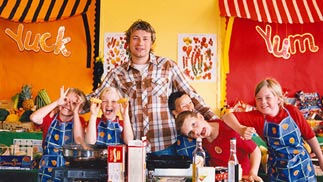
So the big news is out. Jamie Oliver wins the 2010 TED Prize. Each winner receives $100,000 and, more importantly, the granting of “One Wish to Change the World”. Through TED’s extensive network of sponsors, conference attendees and online community, the prize winners have doors to powerful collaborative opportunities swing wide open. (Read more about Jamie’s win here)

Jamie has spent years trying to revolutionize the way we eat and live by getting us off unhealthy eating habits and getting us to cook again. Even with 12 tv series that’s been aired in 130 countries and 10 cookbooks in 29 languages, Jamie is set to create even bigger change. As far as I can remember, I was a big fan of his campaign School Dinners. His mission was to ban junk food in schools and get kids eating fresh, tasty and nutritious food.

“What we eat affects everything: our mood, behaviour, health, growth, even our ability to concentrate. A lunchtime school meal should provide a growing child with one third of their daily nutritional intake.”

I remember watching an episode where he cooked a tray of food and placed it next to a tray of deep fried chicken nuggets and fries in the dining hall. The kids, who came through the buffet line were so unused to seeing fresh, healthy options, mainly chose to go with the unhealthy stuff they’d been so used to putting in their mouths. They just didn’t know any better. It was a sad realization of how we’ve been conditioned, and why the level of obesity in children has doubled over the last decade. In fact, it’s estimated that the number of obese people in the world will rise to 2.3 billion within the next 5 years!

What’s the situation with schools in Singapore? Looking back, I remember that deep fried chicken nuggets and hot dogs formed a big part of my diet in primary school. Ice cream and fizzy, sugar-laden drinks were easily available too. Things were a little different in Secondary school. There was no ice cream in my first two years there. Frozen yogurt made its way in later on though. I also believe we didn’t have any options to buy coke or any other carbonated drinks. Although I’m not so sure my daily dose of Pokka green tea was a much better choice.

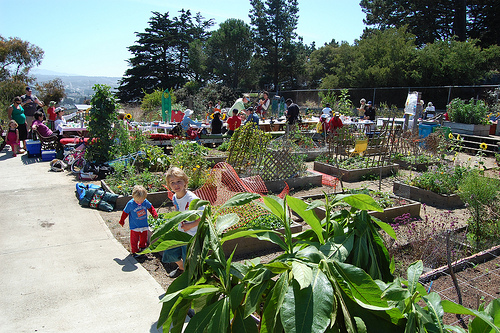
Photo by Kevin Krejci

All this leads me to wonder… what are they feeding students now? Think about it. If they typically have two meals a day, five days a week in that dining hall, that’s a big part of their diets. The system works a little differently back home, where instead of paying for a fixed meal plan for the semester and then getting food from a buffet line, students still have the power in their hands to choose what food to buy from a variety of 8 – 10 different stalls. This means that stall holders are motivated to sell the products that have the highest demand. So apart from getting the authorities to crack down on what can be sold, an alternative way to get healthier choices on the menus is to educate the kids so they start to demand better food.

Health education from books isn’t cutting it anymore. Take them out to visit farms and gardens. Teach them through hands-on practice ways to do urban farming. Get experts to come into class to give real life examples of what they can do. So much can be done!

What was your experience with food in school like?

Subscribe in a reader

Bookmark and Share

Top 10 Eco-Docs of the Decade

Stumbled across an awesome list on Ecorazzi. The top 10 eco-documentaries of the decade. Here’re my 3 highlights from the list.

Fuel (2008)

In the film, Tickell examines America’s addiction to oil and offers viable, sustainable solutions for the future.

Designated a Critic’s Pick by the film reviewers of the New York Times and hailed by numerous other organizations, this Sundance-winning film will change the way you look at biofuels forever.

I had the chance to catch the educational version of Fuel at the SVN Conference earlier and loved how it opened my eyes to the world of Bio-Diesel. Witness how it’s possible for us to run our vehicles on used cooking oil as we watch the Veggie Van make a cross country trip, stopping only at fast-food restaurants to re-fuel. Especially with the tremendous reduction in harmful emissions, it’s one of those things that just makes no sense to not do, really.

I personally have a dream of working with the taxi and bus companies in Singapore to switch over to Bio-Diesel. It’ll take some research and years of work,but the impact is going to be great! :)

[Youtube=http://www.youtube.com/watch?v=upTCSSkxlxE%5D

Who Killed The Electric Car (2006)

Director Chris Paine incited anger towards Big Auto with the release of his electric car documentary in 2006. In particular, General Motors was blamed for killing off their beloved EV1 and stymieing a potential “electric car revolution” in California.

The film currently enjoys am 88% approval rating on Rotten Tomatoes.

A sequel, Revenge of the Electric Car, is planned for release late next year.

I haven’t watched this one, but it looks interesting! Especially with the huge hype over Hybrid cars today. This movie’s exploration of why the quiet, fast and eco-friendly cars that required no gasoline 10 years ago are gone today will set us thinking about who the big bad boys are and why the love of money is destroying our planet.

[Youtube=http://www.youtube.com/watch?v=nsJAlrYjGz8%5D

Who Killed the Electric Car?is available on DVD.

Food Inc. (2009)

the film is divided into three segments examining the production of meat, grains and vegetables, and the economic and legal power of the businesses behind the scenes.

Said one reviewer, “You’re probably not going to like what you see here, but you’d better hold your nose and choke it down anyway. Food, Inc. is for your own good.” The doc currently has an astounding 96% fresh rating on Rotten Tomatoes — with near consensus on it being one of the top must-see documentaries of the year.

I have heard nothing but praise for this movie. Learn the truth about what you’re eating and start demanding good, wholesome food.

[Youtube=http://www.youtube.com/watch?v=5eKYyD14d_0]

Food, Inc.is available on DVD.

Check out Ecorazzi’s full list here.


Subscribe in a reader

Bookmark and Share

Turning Windows into Farms

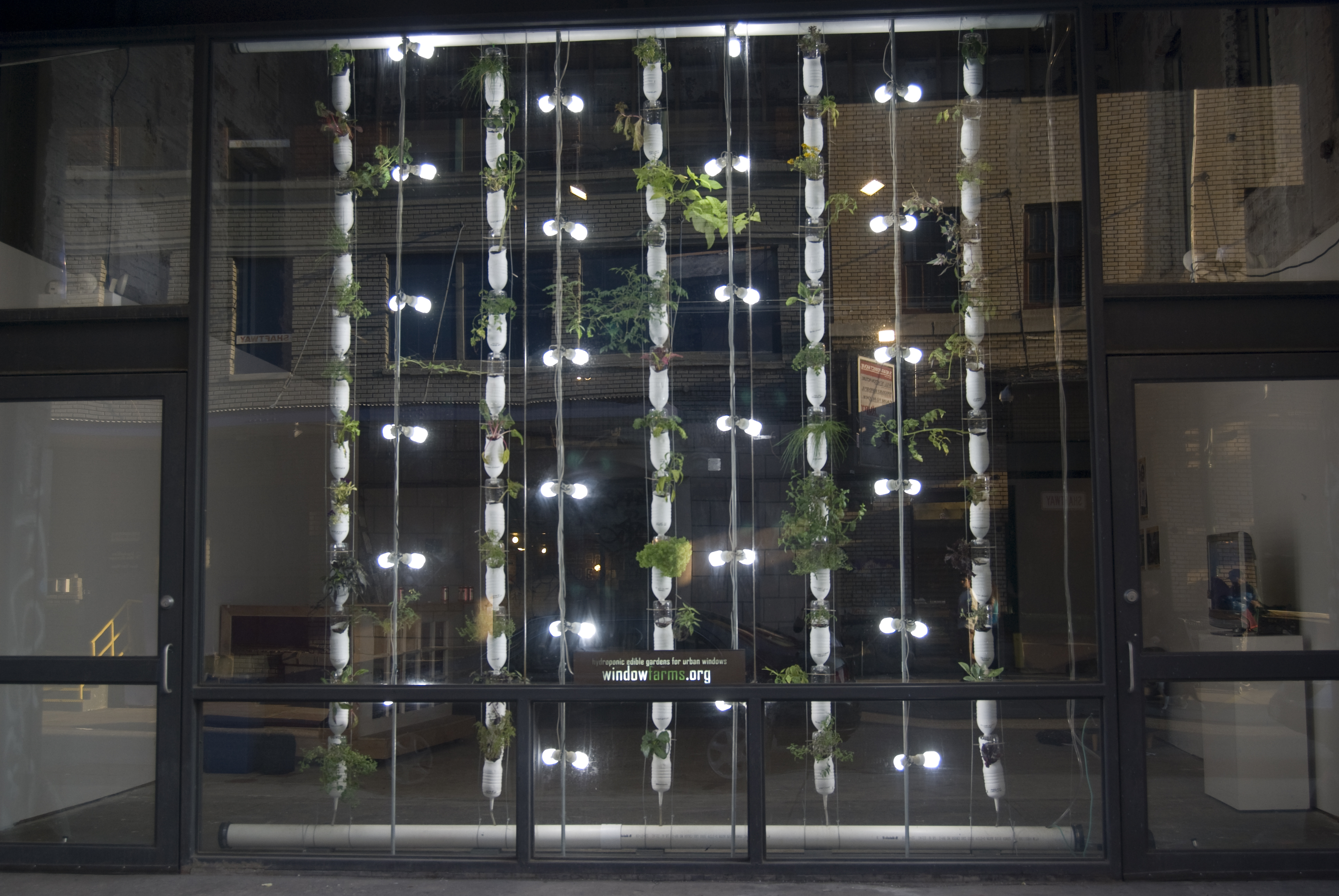
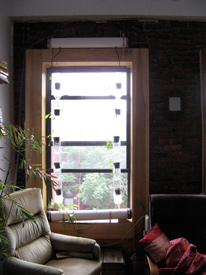
Big window farm at Eyebeam, July 2009. Photo by Lindsey Castillo.

I’m a city girl. I grew up in a place that was pretty much a concrete jungle. And until I was 21, the only farms I’d seen were those on my computer screen when I played Sim Farm. That probably explains why I stared in wide-eyed wonder as Sam drove me around the vast farmlands of Wisconsin. I was so excited that the barns, silos and haystacks looked just like the images painted in my mind by the virtual game!

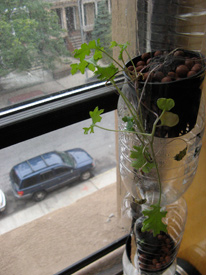
Gabriel Willow's Window Farm, July 2009. Photo by Gabriel Willow.

When I was working on the documentary for Project Green Heals, where we followed 98 high school students on their journeys to learn about urban agriculture, I learned about the great benefits of having food grown close-by. Food grown locally:

  • doesn’t have to be transported over hundreds of miles, so you save on gas and energy.
  • gets to you faster, so it hasn’t lost as many nutrients.
  • has no need for harmful chemical preservatives to keep them looking good longer.

Just like Singapore though, Chicago is a bustling city where buildings fill almost every square foot of the area. Without the huge plots of land, many believe it’s impossible to grow our own food. Fortunately, there are groups out there working to prove that it can be done. Uncommon Ground has turned one of Chicago’s many flat roofs into the country’s first organic rooftop farm.

Gabriel Willow's Window Farm, July 2009. Photo by Gabriel Willow.

The Jane Addams Hull House turned a small plot of land right in the middle of the city into an urban farm, growing enough food to run its soup kitchen to feed the hungry.

But what if you don’t own a restaurant or you’re not part of a large organization? What can we, as regular individuals, do about it?

Window Farms could be the answer. Imagine being able to grow food, right in your own apartment window.

Window Farms are vertical, hydroponic, modular, low-energy, high-yield edible window gardens built using low-impact or recycled local materials.

Learn in less than 3 mintues what it’s all about:

Made from recycled bottles, decorative and food bearing. I find that pretty darn cool. I’d definitely love to give growing my own food a shot in my future home. Has your family ever been into home gardening? What are your thoughts on the Window Farms?